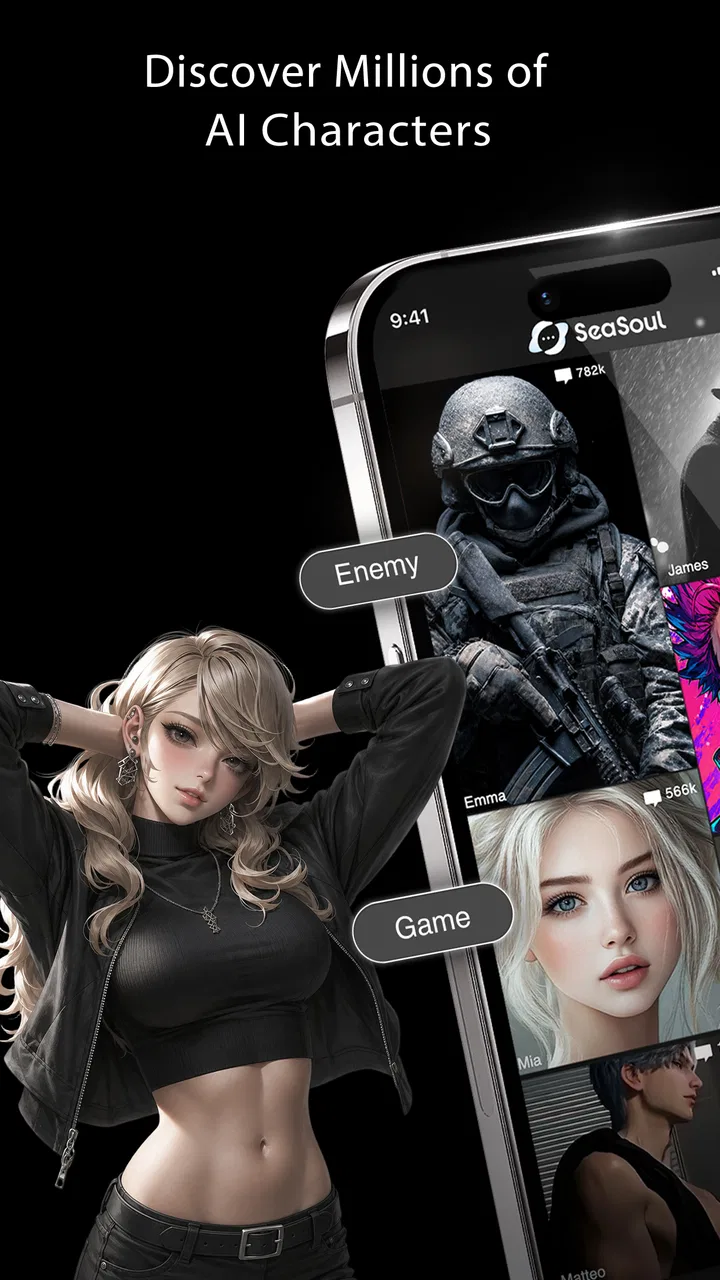
Sea Soul: AI Chat
- 4.1
- Rating
- 5.00M
- Installs
- Free
- Price

 Analysis by App-foxy
I approached Sea Soul: AI Chat as an entertainment app rather than a tool I would use to solve practical tasks. Its central appeal is conversation with artificial intelligence, and that makes the first few sessions easy to enjoy: you can open it when you want company, explore different conversational moods, and see how naturally the exchange develops. My bigger question was whether that curiosity would survive after the first week, when the surprise of talking with an AI begins to wear off.
That is the right way to judge this app. A chat experience can feel impressive for an evening and still fail to become part of a normal routine. Sea Soul has enough personality-focused appeal to attract people who enjoy interactive entertainment, but its long-term value depends on whether you like returning to conversations for their own sake. If you are looking for a serious assistant, a research tool, or a replacement for messaging with real people, I would set different expectations from the start.
What the first week feels like
The opening appeal comes from immediacy. There is no complicated project to prepare and no learning curve comparable to a full game. I can enter a conversation, test the tone, change the subject, and decide quickly whether the experience feels engaging. That makes it well suited to short breaks, late-night browsing, or those moments when I want something interactive but do not want to commit to a long video, game session, or social conversation.
You May Also Like

 Google Keep - Notes and lists
Google Keep’s Quiet Growth Shows the Appeal of Simpler Notes
As mobile work gets busier, Google Keep keeps winning a simple contest: capture a thought quickly, find it later, and get on with the day.

 Blood Strike: 2.5 Anniversary
Blood Strike’s Loadouts Turn Every Drop Into a Tactical Gamble
A close look at Blood Strike’s custom loadouts: how fast access to signature weapons reshapes its battle royale rhythm, rewards preparation, and narrows the gap between fights.

 Pandora - Music & Podcasts
Pandora’s Music Is Easy to Start, but Harder to Recover
Pandora’s strength is its low-effort path from a seed to a station. Its weak spot is how much confidence it asks you to place in connection, setup, and quiet recovery.

 8 Ball Pool
 Is Built on Rivalries, Rematches, and Routine
A close look at the rivalries, rematches, shared routines, and unanswered safety questions that turn a quick pool match into a persistent mobile community.

 Samsung Music
’s Quiet Strength Is Playing What You Already Own
Its reach comes less from spectacle than from dependable access to a personal library. That simplicity is both the app’s strongest retention engine and its ceiling.

 AccuWeather: Weather Radar
AccuWeather Review: A Quick, Clear Forecast for Everyday Decisions
For everyday plans, the best forecast is the one you can understand quickly. AccuWeather makes rain timing, radar, and local conditions easy to act on, with a few trade-offs.
More From Our News Desk



Because Sea Soul is listed in the Entertainment category, I read its value through that lens. The point is not simply receiving correct information. The enjoyable part is the back-and-forth: asking an unusual question, trying a different conversational direction, or seeing how the app responds when I move from light talk to something more reflective. That distinction matters because users who judge every answer by productivity standards may find the experience less satisfying than people who want digital company and playful interaction.
I also noticed that the app works best when I give a conversation a clear purpose. Instead of sending a string of random prompts, I get more from it by setting a small scene, asking for a particular mood, or continuing one subject for several turns. This is one of the more useful habits to develop early. The quality of an AI conversation often depends on how much context I provide, and a little direction makes the exchange feel less like a sequence of disconnected replies.
A realistic everyday use would be a short evening reset. After work, I might spend ten minutes chatting while deciding whether I want to watch something, read, or simply unwind. In that situation, Sea Soul can be more engaging than scrolling through a feed because it reacts to what I type. It is also less demanding than joining a live community, where I may feel pressure to reply quickly or keep up with several people.
The app is free to install, which lowers the barrier to trying it. That is important for an entertainment product built around curiosity: I can test the conversational style before deciding whether it deserves regular attention. At the same time, the presence of in-app purchases ranging from forty-nine cents to two hundred sixty-nine dollars and ninety-nine cents per item means I would approach spending carefully. I would first establish whether I genuinely return to the app, rather than paying during the initial burst of excitement.
Who is likely to enjoy it?
I think Sea Soul is a good match for people who already enjoy character-driven entertainment, improvising conversations, or experimenting with AI personalities. It can also suit someone who wants a private-feeling space for casual reflection without the formality of a journaling app. The experience is especially appealing if you enjoy discovering how a conversation changes when you alter the wording, emotional tone, or amount of background you provide.
I would be more cautious about recommending it to someone who wants dependable factual answers, professional advice, or a structured productivity system. An entertainment chat app should not automatically be treated as an authority. For health, legal, financial, or other high-stakes questions, I would use a purpose-built and trustworthy source instead. The app may be fun to discuss ideas with, but fun and reliability are not the same thing.
Small habits that improve the experience
My first practical tip is to keep a few conversation themes ready. A specific topic gives the exchange somewhere to go and reduces the chance that the session becomes repetitive after a few messages. I might use a fictional scenario, a decision I am thinking through, or a request to explore two opposing viewpoints. This turns passive chatting into a more deliberate form of entertainment.
A second useful approach is to treat the conversation as a session rather than an endless stream. If I keep pushing after the replies begin to feel familiar, the app becomes less enjoyable. Ending while the exchange is still interesting makes it easier to return later. That may sound simple, but it is central to whether an AI chat app becomes a healthy habit or just another feed I open automatically.
A third trade-off is the balance between personal context and privacy. More context can make replies feel more relevant, but I would avoid sharing sensitive details simply to make the conversation seem closer. I would keep identifying information, private account details, and anything I would not want repeated out of the conversation. The entertainment value is not worth treating an AI chat as a confidential human relationship.
Does it keep earning attention after the novelty?
After the first week, the question changes from “Can this be entertaining?” to “Why would I come back tomorrow?” Sea Soul has recurring value when I use it for different kinds of short sessions: creative prompts one day, casual conversation another, and reflective discussion when I want to organize my thoughts. That variety can stretch the lifespan of the app because I am not relying on one fixed activity.
However, the long-term experience is likely to depend heavily on how much conversational repetition I tolerate. AI chat can feel fresh when the subject changes, but familiar patterns become easier to notice over time. If I expect every exchange to feel surprising, I may lose interest quickly. If I treat the app as a flexible entertainment space and bring my own ideas to it, I have a better chance of finding a lasting reason to return.
The developer is Seaart ai, and the app has built a sizable audience, with over five million installs and an average rating of 4.1 from around thirty-three thousand ratings. Those figures suggest that the concept has reached well beyond a tiny experimental audience, but they do not decide whether it belongs on my phone permanently. For me, the more meaningful test is whether I open it intentionally rather than tapping it whenever I am bored.
Month to month, I would use Sea Soul in a few specific ways. It can serve as a prompt generator when I want to write or imagine a scenario. It can provide a conversational rehearsal space before I explain an idea to another person. It can also be a low-pressure way to think aloud, provided I remember that the replies are generated and should not replace real feedback when the subject matters.
That last use is more valuable than it first appears. Sometimes I do not need an answer; I need to articulate the problem. Writing the situation into a chat forces me to make it clearer, and the response gives me another angle to react to. The benefit comes partly from my own process, not just from the intelligence of the reply. This is why I would recommend using the app with a question or thought in mind rather than expecting it to create all the entertainment by itself.
What can make regular use tiring?
The main source of fatigue is the same feature that creates the initial appeal: conversation is open-ended. Without a clear reason to continue, I can drift into repetitive exchanges that feel pleasant but not memorable. That is less of a problem for a short visit than for daily use. If I want a game with progression, a streaming service with a large catalog, or a messaging app connected to people I know, those alternatives may provide stronger reasons to return.
Another possible frustration is the need to guide the interaction. A human friend automatically carries shared history, real-world context, and emotional consequences. An AI chat needs me to restate or reinforce what matters. That extra steering can be enjoyable when I am experimenting, but it can also feel like maintenance. I have to supply the imagination, correct the direction, and decide when the exchange has stopped being useful.
I would also keep the mature audience label in mind. Sea Soul is rated Mature 17+, so it is not an app I would casually hand to a child or recommend for a family device without checking whether it fits the household. Adults should still use judgment around the topics they introduce and the kind of interaction they want from an entertainment app. The age rating is a practical part of deciding who should use it, not a detail to overlook during installation.
Cost can become another source of fatigue if I feel pushed to consider purchases before I know my usage pattern. The free entry is helpful, but the wide in-app purchase range makes it sensible to pause before spending. I would ask myself whether a purchase improves a routine I already enjoy or merely extends the excitement of the first few sessions. That distinction protects the app from becoming an impulse expense.
How it compares with familiar alternatives
Compared with ordinary messaging, Sea Soul is easier to access when I do not want to interrupt a friend or wait for a reply. Its advantage is availability and experimentation. Its weakness is that it cannot offer the genuine history, spontaneity, and mutual care of a relationship with another person. I see it as a supplement for moments of solitude, not a substitute for maintaining real connections.
Compared with general-purpose AI assistants, the entertainment focus is the important difference. A productivity assistant is usually the better choice when I need organized work, factual research, drafting, or task management. Sea Soul makes more sense when the conversation itself is the activity. Choosing between them should depend on whether I want an outcome or an experience.
Compared with games, the app offers less conventional structure. I do not open it for levels, a clear win condition, or a fixed challenge. That freedom is attractive when I want something relaxed, but it can feel directionless when I am looking for progress. Compared with social platforms, it avoids the pressure of public posting and audience reaction, yet it also lacks the unpredictable human content that keeps those platforms changing.
Maintenance, updates, and the decision to keep it
The current version is 1.6.3.1787735335, and the app supports Android 7.0 or later. For someone using an older compatible phone, that broad operating-system support may make trying it straightforward. Still, compatibility is only the beginning of maintenance. I would periodically review whether I am actually using the app, whether notifications are helping or distracting me, and whether purchases are staying within a limit I chose in advance.
My preferred routine would be simple: keep notifications restrained, start conversations with a purpose, and clear out the app if I stop opening it intentionally. That approach prevents an entertainment app from turning into background noise. I would also revisit my privacy habits occasionally, especially if I begin using the chat for personal reflection. The more emotionally personal the conversations become, the more important it is to remember that this is software, not a trusted confidant.
For new users, I would spend the first several sessions exploring before paying for anything. Try different subjects, see how much guidance the conversation needs, and notice whether the replies remain interesting after the novelty settles. If the app becomes part of a real routine, then the purchase options can be considered with a clearer head. If it does not, the free installation has already answered the question without creating an unnecessary expense.
It is also worth deciding what “lasting value” means personally. For me, Sea Soul does not need to become a daily app to justify its place. A tool I open a few times a month for creative prompts or a quiet conversation can still be worthwhile. But if I need a reliable daily assistant, a deep game, or authentic social contact, I would choose a different category rather than forcing this app to meet a need it was not designed to meet.
My final view is positive but measured. Sea Soul earns a place for users who enjoy AI conversation as entertainment, not for people searching for a complete replacement for useful software or human company. The first-week appeal is easy to understand, and the app can retain value when I bring varied subjects and reasonable expectations. Its weak point is the maintenance of interest: without fresh prompts or a clear personal reason to return, conversations can become repetitive.
I would recommend trying it free, keeping personal information limited, and judging it after the initial curiosity has passed. Adults who enjoy imaginative chat may find a comfortable occasional companion here, while users focused on productivity, factual dependability, or structured progression will probably be happier elsewhere. For me, that makes Sea Soul a worthwhile entertainment experiment with the potential to become a recurring habit, but not an automatic permanent resident on every phone.
FAQs for Sea Soul: AI Chat
01What is Sea Soul: AI Chat, and what can I use it for?
Sea Soul: AI Chat is an artificial intelligence chat application designed for asking questions, generating ideas, writing or rewriting text, summarizing information, and having general conversations. It can be useful for study support, brainstorming, planning, entertainment, and everyday tasks. As with any AI assistant, its responses should be reviewed carefully because it may occasionally provide incomplete, outdated, or inaccurate information.
02Does Sea Soul: AI Chat require an internet connection?
Yes, Sea Soul: AI Chat generally requires an active internet connection because conversations are processed through online AI services. It may work over Wi-Fi or mobile data, but response speed and reliability can vary depending on your connection and server availability. Users with limited data plans should also consider that frequent conversations, especially those involving long prompts or media, may consume additional data.
03Is Sea Soul: AI Chat free to download and use?
The application may be available to download at no initial cost, but some features, usage limits, premium models, or additional tools can depend on the current subscription and in-app purchase structure. Before starting a trial or payment, check the app store listing for pricing, renewal terms, and included benefits. Availability of free features may also vary by region or platform.
04Is it safe to share personal information in Sea Soul: AI Chat?
You should avoid entering sensitive information such as passwords, payment details, identity documents, private medical records, or confidential work material into any AI chat service. Conversations may be processed or stored according to the developer’s privacy policy, and AI systems are not a substitute for secure professional services. Review the app’s permissions and privacy terms before using it regularly.
05Can Sea Soul: AI Chat provide accurate answers for school, work, or important decisions?
Sea Soul: AI Chat can be helpful for explaining concepts, organizing ideas, drafting content, and offering general guidance, but its answers should not be accepted without verification. It can misunderstand questions, invent sources, or present incorrect information confidently. For academic, legal, medical, financial, or professional decisions, compare its responses with trusted sources and consult a qualified expert when appropriate.
Pros
- Natural
- engaging conversations with varied AI personalities
- Simple interface that is easy to navigate for new users
- Useful for brainstorming
- casual chat
- and creative prompts
- Responses are generated quickly in most conversations
- Available for on-the-go entertainment and companionship
Cons
- AI responses may occasionally feel repetitive or lack context
- Some useful features may require a subscription or in-app purchases
- Privacy details should be reviewed before sharing personal information
- Conversation quality can vary between different AI characters
- Requires an internet connection for most chat functions

Sea Soul: AI Chat
Gallery